Monmouth County Route 20 and Main Street Roundabout Project, Borough of Manasquan
Project Background
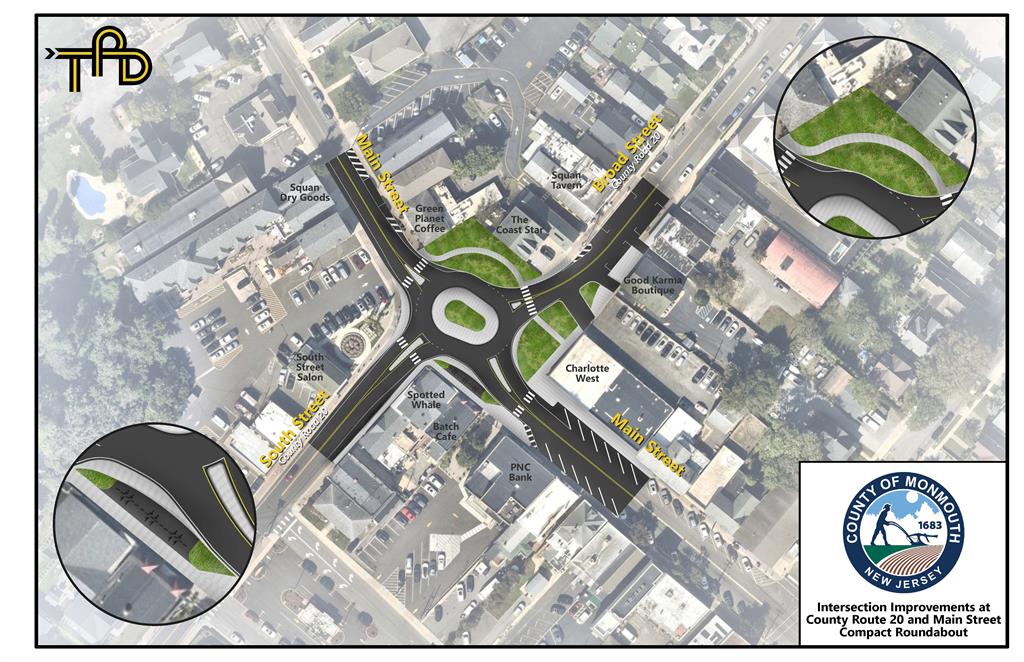
Monmouth County is advancing a project to improve traffic operations and pedestrian safety at the intersection of County Route 20 (Broad Street and South Street) and Main Street in the Borough of Manasquan. The existing intersection is offset and unsignalized, with two-way stop control on County Route 20 (Broad Street/South Street). The purpose of this project is to improve the overall safety, traffic operations, and efficiency of the intersection. The intersection currently experiences traffic backups during weekday peak periods. This is due, in part, to the intersection’s offset geometry and the high volume of vehicles traveling through the intersection on Broad Street and South Street. The minimal spacing between South Street and Broad Street results in a high number of “jog” maneuvers, which can interfere with the relatively uninterrupted flow of traffic on Main Street. When adequate gaps in Main Street traffic are not available, vehicles attempting to jog between Broad Street and South Street can impede traffic flow and contribute to congestion. Crash data within the study area was also reviewed. A total of 24 crashes were documented during the three-year study period. The three most common crash types were rear-end crashes (25%), left-turn crashes (17%), and backing crashes (17%).
Working closely with the Borough of Manasquan, Monmouth County has selected the construction of a
modern roundabout as the preferred improvement alternative for the intersection.
What Is a Modern Roundabout?
A modern roundabout is a circular intersection in which entering traffic yields to vehicles already circulating around a central island.
Modern roundabouts are designed to:
• Reduce vehicle speeds;
• Reduce the frequency and severity of crashes;
• Improve traffic flow and intersection capacity; and
• Improve safety for motorists, pedestrians, and bicyclists.
More than 11,000 roundabouts are currently in operation throughout the United States, reflecting the growing use of modern roundabouts as a proven safety and traffic-management solution.
Safety
Modern roundabouts create a safer environment for motorists, pedestrians, and bicyclists by reducing vehicle speeds and the number of conflict points between vehicles. Roundabouts eliminate head-on, left-turn, and angle-type crashes, which are among the types of crashes most likely to result in serious injuries. Crashes that do occur at roundabouts are generally less severe, such as sideswipe crashes. Approximately 2,300 people are killed each year at intersections controlled by traffic signals. Compared with signalized intersections, modern roundabouts have been shown to reduce total injury crashes by approximately 76% and total fatal crashes by more than 90%.
How Is a Modern Roundabout Different from an Older Traffic Circle?
Modern roundabouts operate differently from the older “New Jersey-style traffic circles” that many motorists may be familiar with.
Single-lane operation:Many older traffic circles have two lanes of traffic circulating around the central island, which can allow for passing and lane changes. The proposed Manasquan roundabout will have
one circulating lane, simplifying navigation and reducing potential conflicts.
Smaller footprint and lower speeds:Many older traffic circles are more than 600 feet in diameter. The proposed Manasquan roundabout will be
less than 120 feet in diameter. Its compact design is intended to keep vehicle speeds below approximately 20 mph, compared with speeds of more than 35 mph that can occur in a typical larger traffic circle.
Clear right-of-way:Older traffic circles may lack clear signage, which can leave motorists uncertain about how to navigate them. The Manasquan roundabout will include
YIELD signs on all entering approaches, rather than STOP signs or traffic signals. Vehicles will enter the roundabout when adequate gaps in circulating traffic are available. This allows traffic to continue moving and is expected to reduce unnecessary stopping, increase capacity, and minimize delays.
Roundabout vs. Traffic Signal
The Federal Highway Administration has established a series of criteria, known as “warrants,” for determining whether a traffic signal is justified at an intersection. These warrants are included in the Manual on Uniform Traffic Control Devices (MUTCD), which is adopted by New Jersey State Statute. The State of New Jersey and its counties use the MUTCD warrants when evaluating whether an intersection should be signalized. Although the Manasquan intersection meets the required warrants for signalization, the Monmouth County Engineer’s Office determined that a traffic signal would provide inefficient operations because of the offset alignment of Broad Street and South Street. A signalized intersection could result in longer vehicle delays and increased traffic queues. From a construction standpoint, the overall costs of constructing a roundabout and installing a traffic signal are comparable. Although roadway construction costs for a roundabout may be higher than those associated with traffic signals, these costs are offset by anticipated savings of more than $250,000 from eliminating traffic signal equipment and associated electrical work. Roundabouts also offer long-term operational and maintenance savings compared with traditional signalized intersections. Because there are no traffic signals to power and maintain, the roundabout could provide an estimated taxpayer savings of approximately $5,000 to $10,000 per year.
Trucks and Large Vehicles
The proposed Manasquan roundabout has been designed to accommodate school buses, trucks, and other large vehicles that are legal in size and permitted for safe travel on public roadways.
Because larger vehicles require additional space to maneuver, the roundabout will include a
mountable truck apron around the central island. This area provides additional space for the rear wheels of larger vehicles while maintaining the compact design necessary to control vehicle speeds.
Construction
Construction of the Manasquan roundabout is being funded by Monmouth County.
Road work is anticipated to begin in
January 2027 and be completed in
early summer 2027. During construction, motorists should anticipate a
30- to 40-day road closure and detour. Access to all driveways and businesses within the project area will be maintained throughout construction.
Questions and Comments
Questions or comments regarding the project may be directed to the
Monmouth County Engineering Division:Phone: 732-431-7760
Email: Robert.Strang-Wolf@co.monmouth.nj.us
Page Last Updated: 8/28/2026 2:29:00 PM