FREEHOLD, NJ – The Monmouth County Board of Chosen Freeholders has launched an innovative solar-powered lighting technology pilot program for street and traffic lights that could save County taxpayers millions of dollars.
 “This project has solar panels that are designed for maximum efficiency and can generate power even on cloudy days,” said Freeholder Director Thomas A. Arnone, liaison to the Department of Public Works and Engineering. “An off-grid lighting system provides both economic and environmental benefits to Monmouth County as it will eliminate the need to run electricity to the lamp posts and reduce gas emissions related to the production of electricity.”
The LED lighting system uses advanced technology to achieve maximum performance and efficiency.
The use of LED lighting makes for a more efficient fixture compared to other types of lamps due to their lower wattage and longer lifetime. The batteries are 100 percent recyclable lithium iron phosphate batteries that have up to 5,000 charge cycles which gives these batteries a lifetime of at least 10 years.
Solar panels placed on the batteries are able to generate 100 percent of the energy needed to power the lights, which eliminates the need for grid-powered electricity.
Two solar LED lighting systems have been installed as part of a pilot program: one at the County’s Library Headquarters in Manalapan and a second location in Freehold at Monument Park in front of the Monmouth County Courthouse.
“In addition to street lighting, the County is looking at plans to install and test solar traffic light system,” said Freeholder Gary J. Rich. “The need for reliable alternatives to the electric grid has become apparent due to temporary power outages caused by severe weather conditions.”
In recent years, the County has endured severe snow and rain storms, Hurricane Irene, and Superstorm Sandy that have tested the emergency preparedness of the County and caused multi-day power outages lasting as long as two weeks.
The County of Monmouth operates and maintains over 200 signalized intersections throughout the County. When the electric power grid is interrupted, the current backup battery system is able to supply enough power to operate the signal for two to six hours and requires approximately five days for recharging. 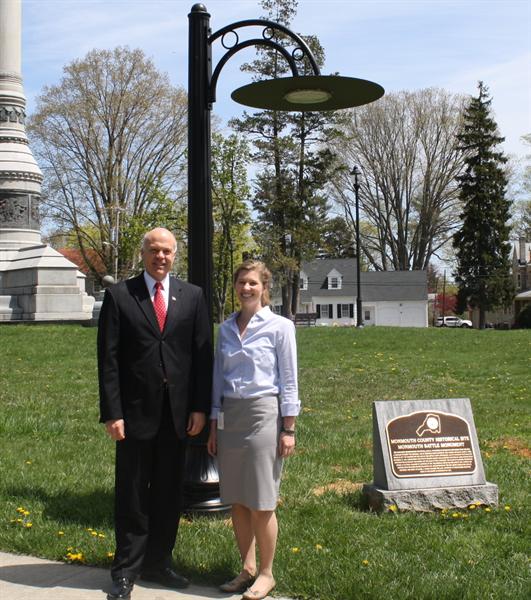
“During extended power outages, valuable resources must be used to ensure the safety of all motorists,” said Rich. “Often times, police officers are stationed at intersections to direct traffic, or portable generators which require refueling and maintenance are set up to operate the signalized intersection. Other alternatives include road closures, the use of four-way stops or detours which are disruptive to traffic flow.”
The goal of this project is to develop a system that uses solar power to recharge backup batteries. These batteries will be able to keep a signal in operation for approximately 24 hours without electricity. Incorporating solar panels into the backup power supply will enable the batteries to be recharged continuously on-site.
“The solar panels will be mounted to the arm of a traffic signal and connected with the signal power supply,” said Arnone. “It is our hope to be able to return excess solar-generated electricity back to the grid, providing further economic benefits to this project.”
# # #