For Immediate Release:
February 4, 2010
County prepares to battle snowstorm
Public Works crews gearing up with salt spreaders, snowplows
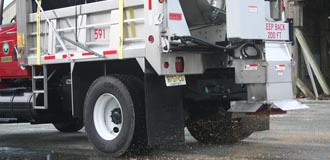
FREEHOLD, NJ – Meteorologists are predicting snowfall in Monmouth County tomorrow into Saturday, and the county’s Public Works crews are busy preparing to keep the county roads clean.
On Friday, road crews from the county’s Department of Public Works & Engineering will begun applying liquid salt brine to many of the county’s roads in order to prevent the snow and ice from bonding to the road surface. The county has about 1,000 lane miles of roads. Crews also will be applying rock salt treated with magnesium chloride.
“We begin preparing well in advance of a winter storm,” said John W. Tobia, director of the county’s Department of Public Works & Engineering. “Our snow room is activated and we will be monitoring its progress throughout the day Friday and over the weekend. We will have a full complement of crews out clearing the roads.”
The county puts into service all 115 trucks outfitted with spreading and plowing capabilities to combat snowstorms, Tobia said.
A blizzard warning has been issued for southern New Jersey. A winter storm warning has been issued for the rest of the state. Southern New Jersey is expected to experience 12 to 18 inches of snow, with the potential for up to 24 inches in certain locations. Central New Jersey is expected to receive 6 to 12 inches, with lesser amounts over northern portions of the state.
“Monmouth County is fortunate to have skilled and dedicated road crews that will be working before, during and after the storm to keep the county’s roads safe during bad weather,” said Freeholder John P. Curley, who oversees the Department of Public Works and Engineering.
This is the third winter the county has applied the salt brine and magnesium chloride-treated rock salt. The salt brine and a pre-application of treated rock salt prevent the snow and ice from bonding to the roads, and the treated rock salt is environmentally friendly. It does not burn the grass or other roadside vegetation nor does it corrode the trucks or the steel bridge spans.
“The key is to keep the ice and snow from bonding to the road surface,” Tobia said. “You may notice that the lanes will be slushy instead of iced over. That’s the first step before the plows come by and push it all aside.”
As a result, there have been far fewer telephone calls from local police departments with regard to trouble spots, Tobia said. Typically, when police dispatchers call to report icy conditions – usually on bridges or curved roadways –the county dispatches additional trucks to do some spot treatments.
The new rock salt works much better than the old rock salt, which was very corrosive to bridge structures, roadside vegetation, the roadway itself and trucks and equipment, Tobia said.
“We have found that magnesium chloride-treated rock salt is much more effective and, therefore, there is a savings in man hours and material,” he said. “We use approximately 20 to 30 percent less material, depending on the snow event, for the same result.”
# # #